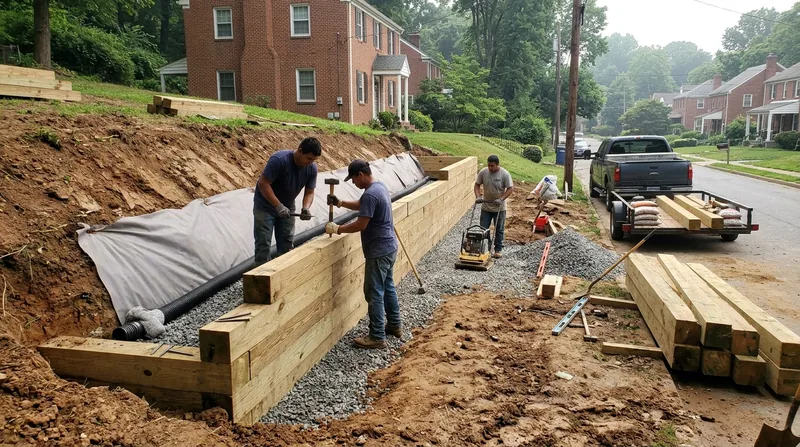




Timber Retaining Walls in Baltimore are the honest, budget-friendly answer for low garden beds, small terraces and grade breaks that do not need to hold back a driveway or a house. This city climbs fast from the flat, filled harbor ground of Canton and Fells Point up into steep stream valleys along the Jones Falls, Gwynns Falls and Herring Run, and the yards in between show every kind of wall: old fieldstone and granite, poured concrete, segmental block terraces and plenty of rotting timber beds. If you live in a brick rowhouse in Federal Hill or Hampden with a postage-stamp back garden, or on a hilly, wooded lot in Roland Park or Mount Washington where the grade drops six feet behind the kitchen, a pressure-treated timber wall can hold that soil for a fraction of the cost of block or concrete. We build timber walls that drain, tie back and stay put, and we tell you straight when timber is the wrong call. Start with our retaining wall installation page to see how a new build comes together.
Why Timber Walls Still Make Sense on Baltimore's Steep, Clay-Heavy Lots
Baltimore's clay-rich soils and freeze-thaw winters are hard on any retaining wall, and timber takes the worst of it. The city's older neighborhoods sit on grades that were cut and filled a century ago, and the summer cloudbursts and tropical storm rain that roll through push water into every seam. Timber is not the longest-lived material, but for a two- to four-foot garden bed or a low terrace it is affordable, fast to build and easy to replace later.
- Timber costs far less per square foot than block or poured concrete, which matters on tight Baltimore budgets.
- We can build a low timber bed in a single day on most rowhouse lots in Canton or Parkville.
- Pressure-treated lumber handles the wet-dry cycle better than untreated wood and resists rot for years.
- Timber walls suit planted terraces where the wall is a backdrop, not a structural hold.
- We flag the spots where clay soil and a steep grade mean block or concrete is the smarter spend.
If your wall is already bowing or the timbers are soft, our retaining wall repair crew can tell you whether it can be saved or should come out.
Key info: In Guilford and Roland Park, many timber beds sit on slopes that drain toward the house. We check the grade before we set a single timber, because a wall that traps water against a 1920s foundation causes more damage than the wall itself.
Before you build, check the Maryland Department of Housing and Community Development for contractor and permitting guidance that applies in Baltimore.
How We Build a Timber Wall in Baltimore, Step by Step
We do not drop timbers on the dirt and call it a wall. Every timber wall we build follows the same sequence, whether it is a small bed in Dundalk or a tiered terrace in Ellicott City. The steps below are what you should expect on site, and they are the difference between a wall that lasts fifteen years and one that leans by the third spring.
- We walk the grade and mark the wall line, checking setbacks and the property line before any digging starts.
- We excavate a level trench and compact a crushed-stone base so the first course sits below grade and bears evenly.
- We set the first course of pressure-treated timbers dead level, then dead-man anchors tie each course back into the slope.
- We install gravel backfill and a drainage path behind the wall so clay soil and storm water do not load the timbers.
- We stagger the joints, spike the courses together and cap the wall, then backfill and compact in lifts.
Every timber wall gets a drainage plan, because water is what kills walls in this city. See how we handle that on our retaining wall drainage page.
Key info: On a Mount Washington lot we rebuilt last spring, the old timber bed had no gravel behind it and the clay held water like a bowl. We pulled the rotted courses, cut in a drainage path and rebuilt with dead-men every four feet. The bed has not moved through two freeze-thaw cycles.
Timber Wall Approaches We Use in Baltimore
Not every timber job is the same, and the right approach depends on height, soil and what the wall has to hold. The table below shows the methods we use most often across Baltimore and Baltimore County, and what each one is best suited to.
| Approach | Description | Best for |
|---|---|---|
| Single-course timber bed | One to two courses of pressure-treated timber on a compacted stone base with gravel backfill. | Low garden beds and planters in Canton, Federal Hill and Hampden. |
| Dead-man anchored wall | Each course tied back into the slope with timber dead-men and gravel fill. | Two- to four-foot walls on clay slopes in Parkville and Catonsville. |
| Tiered timber terrace | Two or more short walls stepped up a slope, each draining independently. | Hilly, wooded lots in Roland Park, Guilford and Mount Washington. |
| Timber-to-block upgrade | Failed timber comes out and a segmental block wall goes in its place. | Walls over four feet or holding a surcharge in Owings Mills and Columbia. |
We size the approach to the grade, not the other way around, so the wall you get matches the job it has to do.
Timber Retaining Walls Cost in Baltimore: What to Expect
Timber wall pricing starts around $20 per square foot, and that figure covers the lumber, base stone, gravel backfill, anchors and labor for a standard low wall. From there, price moves with height, access and soil. A tight rowhouse lot in Fells Point where we hand-carry timbers through a gangway costs more per foot than a wide-open yard in Glen Burnie where a truck backs right up.
Three things move the number most: wall height and the number of courses, how much excavation the slope needs, and whether old failed timbers have to come out first. Wet, clay-heavy ground that needs extra drainage adds cost too, but skipping it costs more later. Get two or three written estimates and compare the scope, not just the total. Our full pricing overview lays out where the money goes.
What to Look for When Hiring a Retaining Wall Contractor Near Me in Baltimore
Hiring for a timber wall near me in Baltimore should not feel like a gamble. Ask for proof of license and insurance before anyone touches your yard, and get a certificate of insurance sent to you directly. Get at least two or three estimates in writing, and check recent references on jobs similar to yours, not just photos of a pretty block wall.
Ask who pulls the permit. Many jurisdictions require one for walls above roughly 4 feet measured from the footing, or when the wall supports a driveway or structure, and engineered drawings may be required for tall or tiered walls. Thresholds vary, so confirm with the local building department. If you are in a historic district or an HOA in Columbia or Owings Mills, ask about design review before you sign. Reach us through our contact page to set up a free estimate.
Timber Retaining Walls in Baltimore: Pricing Guide
| Service | Price | Details |
|---|---|---|
| Low timber garden bed | Starting at $20/sq ft | Includes pressure-treated lumber, stone base, gravel backfill and labor for walls up to two feet. |
| Anchored timber wall | Starting at $28/sq ft | Adds dead-man anchors and deeper excavation for walls up to four feet on clay slopes. |
| Tiered timber terrace | Starting at $35/sq ft | Multiple stepped walls with independent drainage, priced by total wall face and slope height. |
| Timber removal and rebuild | On estimate | Old rotted courses come out first, and hauling plus disposal varies by volume and access. |
| Travel | Included | In Baltimore and surrounding areas, no separate call-out or mileage fee. |
| Estimate | Free | Response within 24h at (443) 806-9687, no obligation to book. |
Indicative pricing, the exact cost depends on square footage, finish, and site access. Free personalized estimate within 24h at (443) 806-9687.


