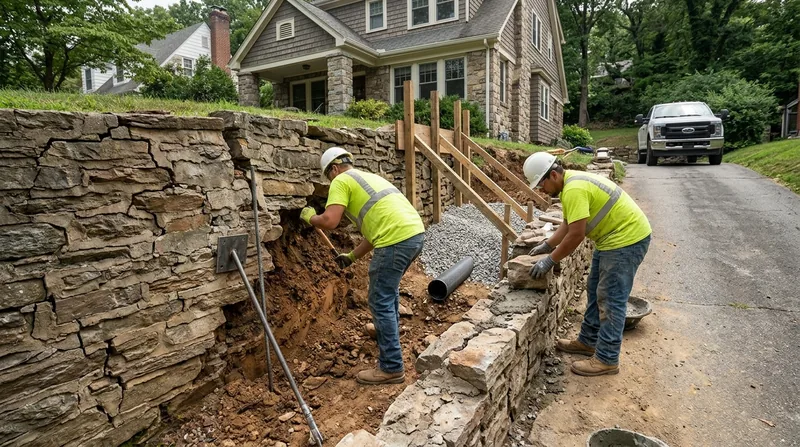




Retaining Wall Repair in Baltimore
Baltimore sits on a slope that climbs from filled harbor ground up through the Jones Falls, Gwynns Falls and Herring Run stream valleys, and every wall in the city takes the weight of that grade. If your block wall is bulging in Canton, your CMU driveway wall is cracking in Parkville, or an old fieldstone wall is leaning in Mount Washington, Retaining Wall Repair in Baltimore stops the movement before it becomes a collapse. We work on poured concrete, CMU, segmental block, fieldstone, granite and timber walls across the city and Baltimore County. The problem is almost never the wall alone. It is water, clay soil and freeze-thaw working together season after season. We diagnose which one is driving the failure, then fix it at the source. For full rebuilds beyond repair, see retaining wall replacement.
Why Baltimore Walls Fail: Clay Soil, Steep Grades and Freeze-Thaw
Most of Baltimore's residential walls were built into clay-rich soil on grades that shed water fast during summer cloudbursts and tropical storm rain. That clay swells when it soaks and shrinks when it dries, and the cycle pushes walls out of line. In winter, freeze-thaw works the same joints open again and again. Early-1900s walls in Roland Park and Guilford were often built without drainage, and 1940s-60s brick Capes across the county carry CMU walls that have been quietly taking water for decades.
- Water pressure behind the wall pushes the base outward and tips the top forward.
- Clay soil heaves under the footing and cracks the wall from the bottom up.
- Clogged or missing weep holes and drain tile let water sit against the backfill.
- Tree roots from mature oaks and maples lift footings and open mortar joints.
- Freeze-thaw widens existing cracks every winter until the wall loses its bond.
Fixing the symptom without fixing the water is why so many repaired walls fail again within a few seasons.
Key info: A wall in Hampden that leans after every heavy storm is usually a drainage problem, not a block problem. We have corrected walls on 36th Street where the only real fix was clearing the drain tile and re-grading the soil behind the wall.
Before any structural work, check what your jurisdiction requires. The Maryland Department of Housing and Community Development and your local building department set the rules for walls above roughly 4 feet and for walls that support a driveway or structure.
How We Repair a Failing Wall in Baltimore, Step by Step
We start by finding out why the wall moved. That means digging test pits behind the wall, checking the footing, and looking at how water leaves the site. Only then do we choose the repair method. A wall that is bowing 2 inches in Catonsville gets a different fix than a wall that has already dropped a section in Dundalk.
- We inspect the wall face, footing, drainage and soil, and mark the failure pattern.
- We dig behind the wall to expose the drain tile and confirm where water is trapped.
- We correct the drainage first, with new drain tile, gravel backfill and weep holes.
- We stabilize the wall with tieback anchors, helical anchors or a partial rebuild as needed.
- We rebuild the face, reset caps and re-grade the soil so water runs away from the wall.
- We walk the finished repair with you and explain what to watch for next season.
Every repair ends with a drainage check, because a dry wall behind good drainage stays put.
Key info: On a Guilford wall that had leaned 3 inches toward the driveway, we installed helical tieback anchors and rebuilt the drainage behind it. The wall came back to plumb without tearing out the entire run. For walls that have already dropped a section, see leaning and collapsed wall repair.
Repair Methods We Use on Baltimore Walls
The right method depends on the wall material, how far it has moved, and what it holds back. We match the repair to the wall, not the other way around.
| Approach | Description | Best for |
|---|---|---|
| Drainage correction | New drain tile, gravel backfill, weep holes and re-grading behind the wall. | Walls that lean after rain or show water stains at the base. |
| Tieback and helical anchors | Anchors driven into stable soil pull the wall back toward plumb. | Bowing or tipping walls that are still structurally sound. |
| Partial rebuild | We remove and reset the failed section, then tie it into the sound wall. | Cracked or settled sections of block, CMU or fieldstone. |
| Footing and base repair | We undercut, pour a new footing or add a concrete base beam. | Walls heaving on clay soil or sinking at the base. |
| Surface and joint repair | We repoint mortar, seal cracks and replace spalled caps. | Cosmetic cracking on walls that are still plumb and stable. |
If the wall is beyond repair, we tell you straight and walk you through replacement options.
Retaining Wall Repair Cost in Baltimore: What to Expect
Most retaining wall repairs in Baltimore start around $1,500. That figure covers small drainage corrections, crack repair and minor partial rebuilds. A leaning wall that needs tieback anchors, or a wall that has to be opened up and rebuilt on a new footing, runs higher. The biggest cost drivers are how far the wall has moved, how much soil has to be dug out, and whether the wall holds a driveway or structure.
Access matters too. A wall at the back of a deep rowhouse lot in Fells Point costs more to reach than a wall along a county driveway in Glen Burnie. So does a wall on a wooded slope in Mount Washington where equipment cannot get close. We give you a range after the site visit, not a guess over the phone. Our full pricing overview breaks down the ranges by repair type.
Get two or three estimates before you commit. A contractor who quotes without digging behind the wall is guessing at the cause, and the number will move once the work starts.
Retaining Wall Repair Near Me: How to Choose a Contractor Near Baltimore
Any contractor can patch a crack. The one you want can tell you why the wall cracked and show you the drainage fix that keeps it from coming back. Ask questions before you sign anything.
- Confirm the contractor is fully insured, and ask for a certificate of insurance.
- Get at least two or three written estimates that describe the repair method, not just a price.
- Ask for references from jobs in your part of Baltimore and call them.
- Ask who pulls the permit if your wall is above roughly 4 feet or holds a driveway, and verify the threshold with your local building department.
- If you live in a historic district or an HOA, confirm what approvals are needed before work starts.
Reach us through our contact page to set up a free estimate at (443) 806-9687.
Retaining Wall Repair in Baltimore: Pricing Guide
| Service | Price | Details |
|---|---|---|
| Drainage correction and crack repair | Starting at $1,500 | Includes clearing drain tile, new gravel backfill, weep holes and repointing small cracks. |
| Partial rebuild of a failed section | Starting at $3,200 | Covers removing and resetting a failed run of block, CMU or fieldstone and tying it in. |
| Tieback or helical anchor stabilization | Starting at $5,500 | Pulls a bowing or tipping wall back toward plumb without a full tear-out. |
| Footing and base repair | On estimate | Requires opening the base and assessing soil and grade before a number is given. |
| Travel | Included | In Baltimore and surrounding areas, no separate call-out or mileage fee. |
| Estimate | Free | Response within 24h at (443) 806-9687, no obligation to book. |
Indicative pricing, the exact cost depends on square footage, finish, and site access. Free personalized estimate within 24h at (443) 806-9687.


