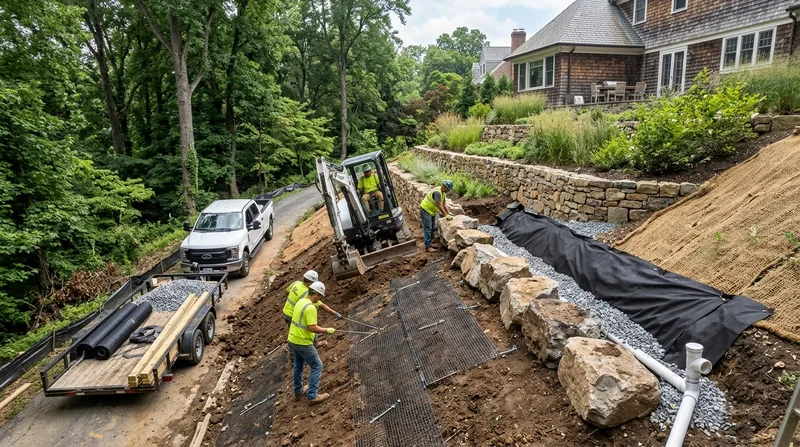




Baltimore is a city built on grade, and that grade is always moving. From the filled harbor ground in Canton and Federal Hill up through the steep stream valleys of the Jones Falls, Gwynns Falls, and Herring Run, water and gravity work on every cut-and-fill lot in town. Slope Stabilization & Erosion Control in Baltimore is the work of holding that grade in place before it takes your driveway, your walkway, or the back corner of your foundation with it. The clay-rich soils across Roland Park, Guilford, and Mount Washington swell in wet weather and shrink in dry spells, and a summer cloudburst or tropical storm rain can open a gully in an afternoon. We build terraced walls, geogrid-reinforced structures, and drainage systems that keep hillsides where they belong. If you are already seeing movement, start with retaining wall repair before the problem grows.
Why Slope Stabilization Matters on Baltimore's Hills and Stream Valleys
Most of the failures we see in Baltimore start with water that has nowhere to go. The 1940s-60s brick Cape Cods and ranches across Baltimore County sit on lots graded decades ago with fieldstone or timber walls that have long since given up. In Owings Mills, Columbia, and Glen Burnie, the 1980s-2000s colonials were built on tighter, steeper lots where a small washout becomes a structural problem fast.
- Clay soil holds water against a wall face and pushes it out of line after a wet spring.
- Winter freeze-thaw cycles crack and heave poorly drained slopes from January through March.
- Storm runoff from uphill neighbors concentrates on cut-and-fill lots and cuts gullies through yards.
- Old timber and railroad tie beds rot at the soil line and release the slope they were holding.
- Tree roots on wooded hillsides in Roland Park and Mount Washington can both anchor and destabilize a slope.
Every one of those failure modes gets worse with time, and the repair bill grows with it.
Key info: A homeowner in Catonsville called us after a July downpour washed out the slope behind a 1950s ranch. The culprit was a blocked footing drain on an old timber wall. We rebuilt the drainage and terraced the slope with segmental block, and the yard has stayed put through two wet seasons since.
How We Stabilize Slopes in Baltimore, Step by Step
We do not guess at a slope. We walk the property, read the grade, check where water is actually going, and locate the failure plane before we quote a fix. On hillside lots in Guilford and Ellicott City, that often means engineering the wall rather than just stacking block. Baltimore City and Baltimore County both have permit thresholds that vary by wall height and surcharge, so we confirm the requirement with the local building department before we break ground.
- We inspect the slope, the existing wall, and the drainage pattern, then identify the failure mode.
- We check property lines and confirm permit requirements with the local building department.
- We design the fix: terraced walls, geogrid reinforcement, surface drainage, or a combination.
- We excavate and prepare the footing to the required depth and compaction.
- We install the wall system and geogrid layers, backfilling in compacted lifts.
- We restore surface drainage and erosion control so water moves away from the slope.
For steep terraces and reinforced walls, see our block and segmental retaining walls page for the systems we use most on Baltimore hillsides.
Key info: On a wooded lot in Mount Washington, a homeowner had a 6-foot drop behind the house that was sliding toward the patio. We terraced it into two 3-foot walls with geogrid and a French drain, which handled the grade without a single tall wall and kept the mature oaks intact.
Slope Stabilization Methods We Use in Baltimore
The right approach depends on the height of the slope, the soil, the water, and what sits above and below it. Here is how the main options compare on Baltimore-area lots.
| Approach | Description | Best for |
|---|---|---|
| Terraced retaining walls | Two or more shorter walls stepped up the slope to break up grade and load. | Residential hillside yards with room to step the grade. |
| Geogrid reinforcement | Grid layers tied into the wall and backfill to stabilize the soil mass. | Taller walls, surcharge loads, and clay soils that push hard. |
| Surface drainage and swales | Grading, swales, and downspout routing to move water off the slope. | Slopes with gully erosion and runoff from uphill properties. |
| Subsurface drainage | Footing drains and French drains that relieve water pressure behind walls. | Wet slopes, clay soils, and walls showing lean or bulging. |
| Erosion control blankets and planting | Blankets, riprap, and deep-rooted plantings to hold bare soil. | Newly graded slopes and stream-bank edges. |
Most Baltimore jobs combine two or three of these methods, because grade and water rarely fail in isolation.
Slope Stabilization & Erosion Control Cost in Baltimore: What to Expect
Every slope is different, so we start every job with a free on-site estimate rather than a phone number. The cost depends on the height and length of the slope, the soil, how much water is involved, and whether the wall needs engineering. Access matters too: a backyard slope in Hampden with an alley behind it is a different job from a wide-open lot in Glen Burnie. Getting two or three estimates is smart on any stabilization project, and it helps you compare scope, not just price.
Small erosion fixes and drainage corrections usually land at the low end. Terraced walls with geogrid and engineered footings sit at the high end, especially where permits and drawings are required. We break the estimate down by line item so you can see what each piece costs. For a fuller breakdown of typical ranges, see our pricing overview.
What to Look for When Hiring a Retaining Wall Contractor Near Me in Baltimore
Hiring the wrong contractor on a slope job is expensive, because a wall that fails takes the slope with it. Ask for proof of licensing and insurance before anyone walks your property. Get at least two or three written estimates with a clear scope, and ask each contractor how they plan to handle water. Check references from jobs in Baltimore County or the city that are at least two years old, so you can see how the work held up.
Confirm who pulls the permit and how the contractor handles property-line setbacks, especially on tight lots in Federal Hill and Canton. If your neighborhood has HOA rules, get the approval in writing before work starts. A contractor who hesitates on any of these questions is telling you something. When you are ready to talk through your slope, contact us for a free estimate.
Slope Stabilization & Erosion Control in Baltimore: Pricing Guide
| Service | Price | Details |
|---|---|---|
| Erosion control and drainage correction | Free estimate | Includes on-site slope inspection, drainage assessment, and a written scope; price moves with slope length and water volume. |
| Terraced retaining wall system | Starting at $4,500 | Covers excavation, footing, block, and drainage for a typical residential terrace; height and geogrid layers move the number. |
| Engineered slope stabilization | On estimate | Tall or tiered walls with surcharge loads need engineering and permits before a number can be given. |
| Travel | Included | In Baltimore and surrounding areas, no separate call-out or mileage fee. |
| Estimate | Free | Response within 24h at (443) 806-9687, no obligation to book. |
Indicative pricing, the exact cost depends on square footage, finish, and site access. Free personalized estimate within 24h at (443) 806-9687.


